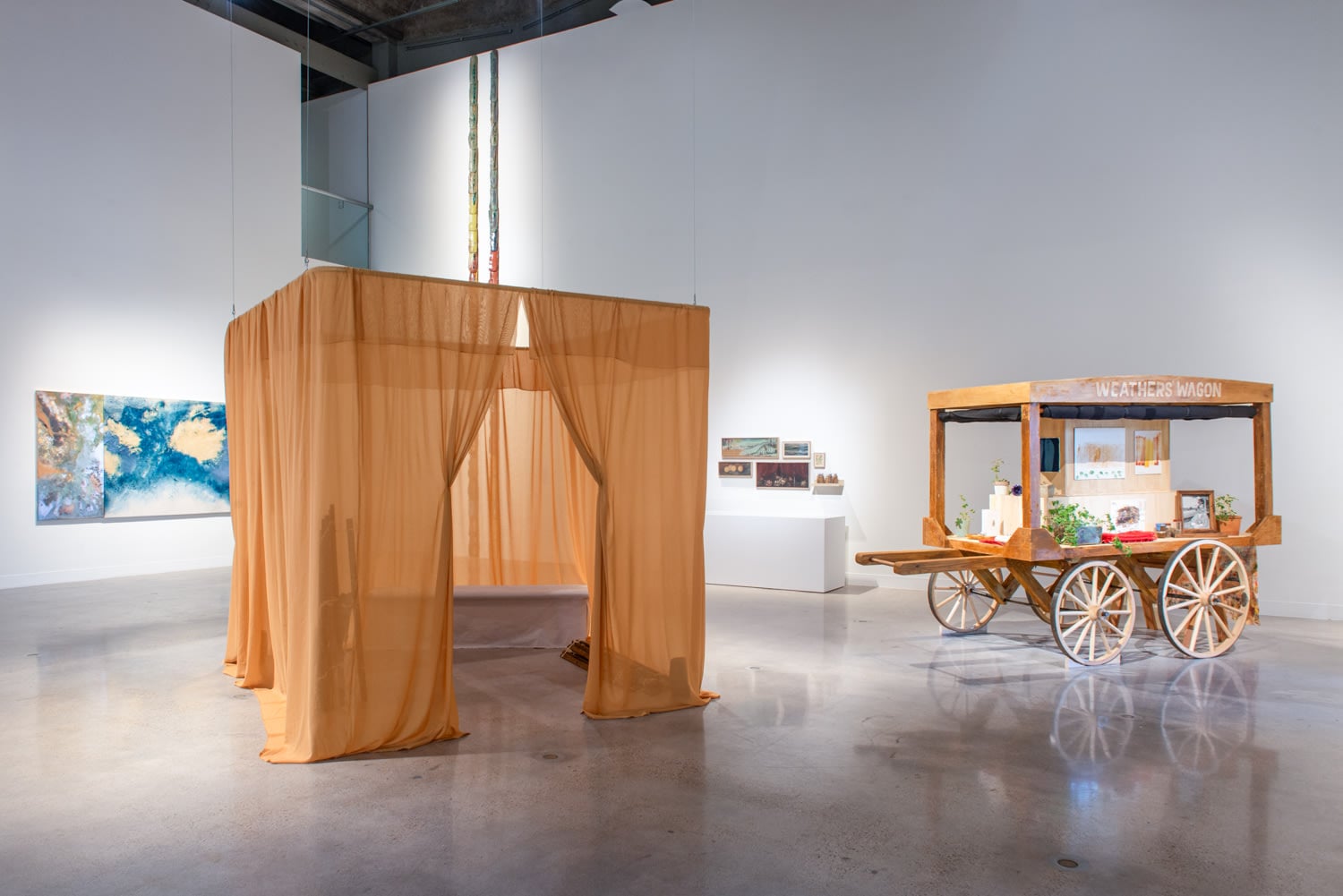
How to Grow the Cowpea: Survival Strategies from the U.S. South is an exhibition presented in partnership with Planet Texas 2050, an initiative supporting interdisciplinary climate resilience research at the University of Texas at Austin. The exhibition assembles new and existing works by artists who probe our relationship with the environment and offer strategies for survival amid the climate crisis. To engage a crisis of this scale, the participating artists operate on a timeline that extends far beyond that of the exhibition itself. Their work builds on legacies of scientific, artistic, and ecological practices that have been in process long before the exhibition, planting seeds for material transformations that will take shape long after the exhibition closes, in forms ranging from heat-resistant gardens to advocacy for the rematriation of the American bison. The exhibition borrows its principal title from an educational pamphlet written by George Washington Carver during his tenure at Tuskegee University. Designed for Black farmers in rural Alabama, the pamphlet offers a holistic blueprint for communal care, pairing research on soil health and nutrition with instruction in financial literacy, agricultural sustainability, and material resourcefulness. Carver’s educational model, which prioritizes accessibility and interdisciplinary methods, directly informs the exhibition’s approach to addressing the immense, disorienting scale of the climate crisis through public pedagogy and the presentation of applied artistic practices. How to Grow the Cowpea is anchored in scientific data collected and shared by the Planet Texas 2050 network, which brings together academic researchers and scientists from diverse fields to develop strategies for equitably adapting to and mitigating the cascading threats of ecological disaster. The exhibition’s co-curators commissioned several artists to create new work in dialogue with Planet Texas 2050 researchers, including scientists who build communication systems for communities in vulnerable floodplains, reconstruct Texas’s paleoclimate, and track how climate change alters bird migration patterns. Across the exhibition, its public programs, and its catalog, How to Grow the Cowpea explores collaborative methodologies to provide accessible, actionable strategies for mutual and environmental care. Participating artists include Saif Azzuz, Imani Jacqueline Brown, George Washington Carver, Mel Chin, ENTRE Film Center, Heather Bird Harris, Angel Lartigue, Marie Lorenz, Anna Mayer, Mark Menjívar, Kate Newby, Sahara Dust Season Collective (Anthony Almendarez, Mashal Awais, Sol Diaz-Peña, larí garcía, Jeremy Johnson, Jack Morillo, Corey De’Juan Sherrard Jr., Paty Lorena Solórzano), Pallavi Sen, jackie sumell, Cecilia Vicuña, and Obie Weathers.
Who's playing
The lineup includes Mel Chin, Cecilia Vicuña, Kate Newby, Mark Menjívar, Pallavi Sen, jackie sumell, Obie Weathers and the Houston-based Sahara Dust Season Collective. George Washington Carver is credited too, since his pamphlet gives the show its title. It is co-curated by the VAC's Melissa Fandos and Erika Mei Chua Holum of The Dock Art Centre in Ireland.
What to expect
Several works were commissioned in dialogue with Planet Texas 2050 researchers who study floodplain communication, Texas's ancient climate and shifting bird migration. Menjívar's piece includes bird photographs, night-call recordings and a chalkboard tally of species. Newby's outdoor sculpture is designed to break down over the run of the show. Sen plants a heat-resistant garden in the courtyard, and Saif Azzuz's charcoal mural greets visitors at the entrance.
Why go
This is climate art that offers practical ideas as well as worry. The curators describe the show as an invitation, with play, hope and care alongside the science. The VAC is a 13,000-square-foot gallery in the Art Building, with concrete barrel-vaulted ceilings by Lake|Flato. It makes an easy campus stop for anyone curious how research turns into something you can walk through.
Where
Visual Arts Center · 2300 Trinity St. · Central, Austin TXDirections